
Product Overview
Distech PDITE-SMRTVUE-01 Temperature Sensor
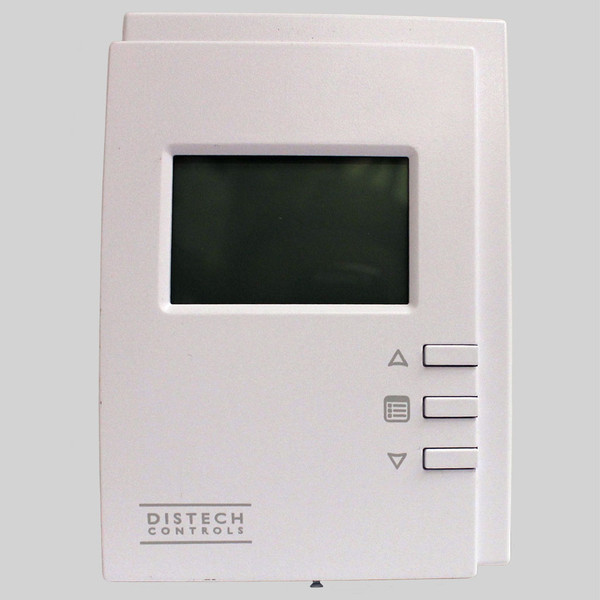
The Distech Controls PDITE-SMRTVUE-01 Allure EC-Smart-Vue Sensor is a communicating room temperature sensor designed for use with Distech Controls ECL, ECB, and ECLYPSE controller series. It monitors zone temperature and provides local access to environmental information through a backlit display, supporting HVAC applications such as VAV systems, fan coil units, rooftop units, heat pumps, and unit ventilators. This model is used as a replacement or service component in building automation systems that require room temperature sensing and controller communication.
Part details:
- Communicating room temperature sensor with backlit LCD display
- Compatible with Distech Controls ECL, ECB, and ECLYPSE controller platforms
- Designed for HVAC applications including VAV controllers, fan coil units, rooftop units, heat pumps, and unit ventilators
- Uses an integrated 10 kΩ NTC thermistor temperature sensor
- RS-485 communications at 38,400 bps
- RJ-45 connectivity with support for daisy-chain room device installation
Documentation:
FAQs:
Q: What is the Distech Controls PDITE-SMRTVUE-01 used for?
A: The PDITE-SMRTVUE-01 is a communicating room temperature sensor used with Distech Controls building automation systems. It measures room temperature and communicates with compatible controllers to support HVAC zone control.
Q: What controllers work with the Distech PDITE-SMRTVUE-01 Temperature Sensor?
A: The PDITE-SMRTVUE-01 is designed to communicate with select Distech Controls platforms, including ECB BACnet controllers, ECL LonWorks controllers, and Eclypse BACnet/IP and Wi-Fi controllers. It can be used in a variety of HVAC applications, including VAV systems, fan coils, heat pumps, rooftop units, and unit ventilators.
Q: What information can be viewed on the PDITE-SMRTVUE-01 display?
A: The sensor includes an LCD interface that can display room temperature and provide access to available menu functions based on the connected controller and system configuration.
Q: What HVAC systems commonly use this sensor?
A: The Allure EC-Smart-Vue series is commonly used with VAV systems, fan coil units, rooftop units, heat pumps, unit ventilators, and other building automation applications requiring room temperature sensing.
Q: Can I change the temperature display between Fahrenheit and Celsius?
A: Yes. Users can switch between °F and °C through the device's user menu. This setting can be adjusted directly from the sensor without accessing advanced configuration options.
Q: How do I adjust the heating and cooling setpoints?
A: Temperature setpoints can be modified from the sensor when the connected controller is operating in the appropriate mode. Adjustments are typically made using the arrow buttons or through the user menu interface.
Q: Is the PDITE-SMRTVUE-01 a temperature-only sensor?
A: The PDITE-SMRTVUE-01 model is identified as a communicating room temperature sensor. The broader Allure EC-Smart-Vue family includes models that may also incorporate humidity, CO₂, and motion sensing, depending on the model number.
Q: Is the PDITE-SMRTVUE-01 suitable for commercial buildings?
A: Yes. The sensor is commonly used in commercial environments that utilize Distech Controls building automation systems for zone monitoring and temperature management.
Q: Does this sensor help improve energy efficiency?
A: Yes. The Allure EC-Smart-Vue product family includes features designed to promote energy-conscious operation and help reduce unnecessary HVAC energy consumption.
Q: Does the EC-Smart-Vue support indoor air quality monitoring?
A: Some models within the Allure EC-Smart-Vue series include CO₂ sensing capabilities and feature an automatic self-calibration system. Available functions may vary by model.
Q: Can multiple room sensors be connected to the same controller?
A: Yes. The Allure EC-Smart-Vue series supports daisy-chain connections and can be used in applications where a controller serves multiple rooms or larger spaces.
Q: How can I tell if a temperature sensor needs replacement?
A: Common signs include incorrect temperature readings, inconsistent room comfort, communication errors between the sensor and controller, or HVAC equipment that does not respond properly to changing room conditions.