
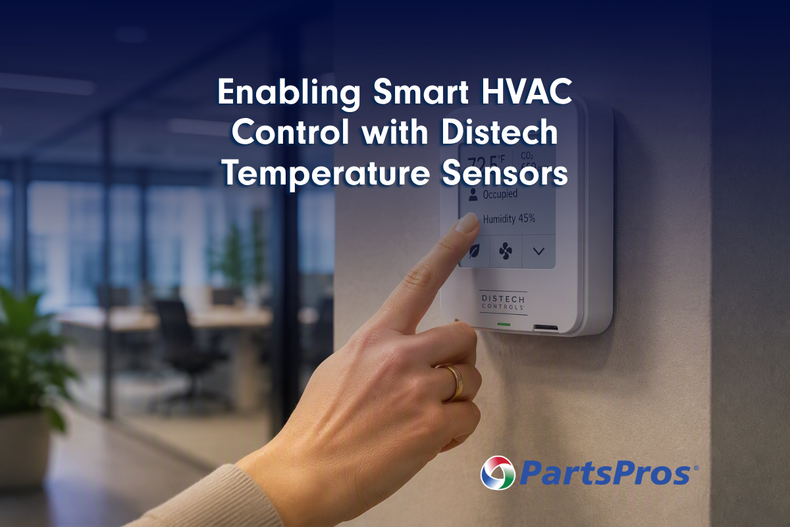
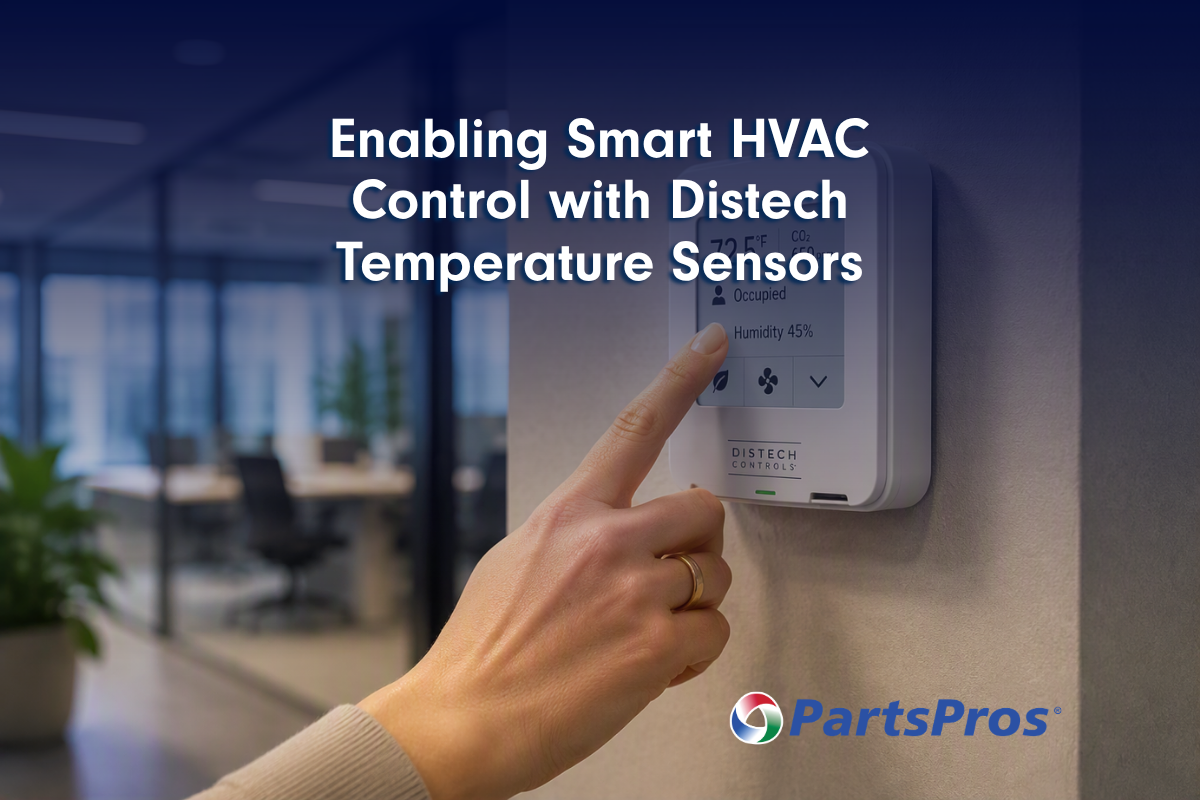
Your HVAC system is only as smart as the data it receives. Inaccurate readings can trigger problems that don’t appear as failures until comfort complaints start rolling in or your energy bills spike. Distech Controls' temperature sensors, like the Allure EC-Smart-Vue, address this problem at the source.
Distech temperature sensors read temperature, humidity, CO₂, and occupancy/motion in a room, and when integrated with building automation systems (BAS), feed it accurate, multi-variable zone data to help enable adaptive strategies. This allows you to make smarter decisions for your building in real time, leading to improved comfort, energy efficiency, and system reliability.
How Distech Sensors Impact HVAC Control
Here are the primary ways Distech sensors enable smarter HVAC control.
- Tighter Temperature Control Loops
Small sensing errors create real control problems. A ±1–2°F inaccuracy at the zone level can cause:
- Simultaneous heating and cooling in the same space
- Overventilation driven by inaccurate load estimates
- Excessive equipment cycling that accelerates component wear
- Reheat energy penalties from overcooled supply air
The Allure EC-Smart-Vue series solves this with ±0.9°F (±0.5°C) accuracy and 0.18°F (0.1°C) resolution. That precision gives your DDC controller a reliable picture of zone conditions, enabling narrower deadbands and tighter control loops without generating comfort complaints.
For multi-zone buildings, zone-by-zone granularity also enables three specific strategies:
- VAV box optimization — Adjust airflow per zone based on real demand, not floor-level averages
- Static pressure reset — Reduce fan energy based on actual zone conditions rather than worst-case assumptions
- Reheat minimization — Avoid overcooling primary air and reduce the conditioning energy needed to correct it
- Demand-Controlled Ventilation (DCV)
Demand-Controlled Ventilation, or DCV, adjusts outside air intake based on actual occupancy rather than fixed schedules. CO₂ is the primary signal: as occupancy increases, CO₂ rises and the system brings in more fresh air. As occupancy drops, outside air intake decreases.
Temperature sensing plays an essential supporting role in DCV. CO₂ answers "Do we need more fresh air?" Temperature answers "What will that cost, and how should we deliver it?" Without accurate temperature input, DCV strategies can shift from energy-saving to energy-intensive.
Distech sensors contribute to effective DCV in four specific ways:
- Load detection — Temperature data prevents overcooling or overheating during ventilation events
- Control coordination — Temperature aligns outside air intake with the heating and cooling response
- Zone validation — Zone-level readings improve the accuracy of ventilation decisions across the system
- Reheat avoidance — Accurate supply air temperature data reduces unnecessary reheat energy
- Occupancy-Based HVAC Control
Distech sensors with motion detection use a passive infrared (PIR) sensor with a 20-foot horizontal detection range to identify whether a space is occupied. When that data feeds into a BAS controller, it enables occupancy-based control strategies that go beyond simple on/off setback.
Practical applications include:
- Reducing heating and cooling output during unoccupied periods
- Lowering outside air intake when a space is empty
- Coordinating lighting and HVAC responses to occupancy changes
- Applying setpoint adjustments automatically, without manual overrides at the BAS
This is especially useful in conference rooms, classrooms, and healthcare common areas—spaces where occupancy can vary greatly and static scheduling wastes significant energy.
- BAS Integration and Global Reset Strategies
Distech sensors integrate natively with BACnet/IP and MS/TP networks, Distech ECL and ECB series controllers, ECLYPSE controllers, and other interoperable BAS platforms. When sensor data feeds into the BAS as part of a larger control ecosystem, it enables global reset strategies that extend energy savings from the zone to the central plant:
- Supply air temperature reset — Raise or lower supply air temperature based on aggregate zone demand
- Chilled and hot water reset — Reduce chiller energy when zone loads are low or adjust heating water temperature based on actual heating demand
- Central plant staging — Use cumulative zone data to inform boiler and chiller sequencing
Each of these strategies reduces energy consumption without requiring occupants to notice or change anything.
- Fault Detection and Diagnostics (FDD) Support
Consistent, accurate sensor data is the foundation of any effective FDD program. Distech sensors support analytics platforms by providing stable baseline readings that can be benchmarked against expected performance over time.
Practical FDD applications include:
- Automated fault detection — Identify stuck dampers, drifting sensors, or failed actuators before they cause comfort or equipment issues
- Performance benchmarking — Flag underperforming zones based on historical trends
- Predictive maintenance — Detect degradation patterns before they result in unplanned failures
- Complaint reduction — Address root causes before they escalate to service calls
Key Features of Distech Allure EC-Smart-Vue Sensors
The Allure EC-Smart-Vue series is available in eight models, each combining any mix of the following sensing inputs:
- Temperature — 10 kΩ NTC thermistor with ±0.9°F (±0.5°C) accuracy and 0.18°F (0.1°C) resolution
- Humidity — ±3% accuracy, 1% resolution
- CO₂ — Non-dispersive infrared (NDIR) sensing with gold-plated optics, 0–2,000 ppm range
- Motion/Occupancy — PIR sensor with Fresnel lens, 20-foot horizontal detection range
Distech Sensor CO₂ Self-Calibration
Distech's ABC Logic (Automatic Calibration Logic) is a patented self-calibration algorithm that eliminates manual CO₂ calibration in most applications. The system records the lowest CO₂ reading every 24 hours and applies a correction factor when statistical drift is detected. Lifetime CO₂ accuracy is guaranteed, provided the space drops to near-ambient CO₂ levels (approximately 400 ppm) at least three times every 14 days—a condition met by virtually any occupied school, office, or healthcare facility during overnight hours.
For your project team, this means fewer calibration site visits and more reliable DCV performance over the sensor's service life.
Occupant Interface with Controlled Flexibility
The Allure EC-Smart-Vue includes a bright LCD display with local setpoint adjustment and occupancy override capability. Occupants can:
- View current space temperature and active setpoint
- Adjust setpoint within defined limits
- Control fan speed
- Apply occupancy overrides without accessing the BAS
This reduces override requests directed at facility staff, improves occupant satisfaction, and keeps the BAS in control of the broader system strategy. The ECO-Vue Leaf Pattern on the display also provides real-time visual feedback that encourages energy-conscious behavior at the occupant level.
Which Facilities Benefit Most from Distech Temperature Sensors?
Distech sensors produce the strongest results in facilities where IAQ, variable occupancy, and energy performance must be managed at the same time. That includes:
- Schools and universities — Variable occupancy by period, high CO₂ loads, lighting and HVAC coordination
- Healthcare facilities — Precision zone control in patient rooms, labs, and common areas; strict IAQ requirements
- Commercial offices — Conference room scheduling, open-plan occupancy variation, central plant optimization
- Senior living facilities — Consistent comfort in common areas, reduced energy waste during off-peak hours
Buy Distech Temperature Sensors from LONG PartsPros
Distech Allure EC-Smart-Vue sensors are available now and have same-day shipping.
Need full specifications before you specify? Download the Allure EC-Smart-Vue tech sheet for wiring diagrams, model selection guidance, and CO₂ calibration documentation. Or contact the LONG PartsPros team directly. Our experts can help you confirm the right model for your application and verify compatibility with your existing BAS platform.