
Product Overview
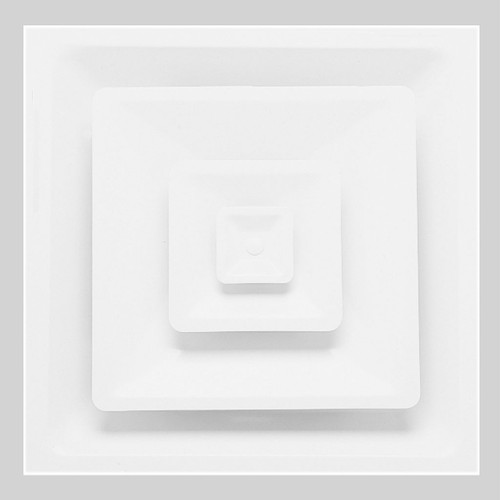
Krueger 1400 14" Diffuser with 4-Cones 24x24
The Krueger 1400 14-inch diffuser is a steel, 4-cone ceiling air outlet with a 24 x 24-inch face panel, a 14-inch round neck, and an F23 lay-in T-bar frame. It is used to distribute conditioned supply air in commercial HVAC systems and is intended for applications requiring a square louvered-face diffuser that connects to round ductwork.
Part Details:
- 14-inch round neck: Sized for connection to nominal 14-inch round ductwork
- 24 x 24-inch face panel: Configured for a two-foot square ceiling opening or grid module
- F23 lay-in frame: The manufacturer defines F23 as its lay-in T-bar frame configuration
- Four-cone, 4-way configuration: Uses four stamped cones to produce a four-way air-distribution pattern
Documentation:
FAQs:
Q: What is the Krueger 140014 ceiling diffuser used for?
A: The Krueger 140014 is a supply-air diffuser used to distribute conditioned air from round ductwork through a commercial ceiling. This configuration combines a 14-inch round neck, 24 x 24-inch panel, and four-way louvered face for ceiling-mounted air distribution.
Q: Is the Krueger 140014 compatible with a 24 x 24-inch T-bar ceiling?
A: Yes. The researched configuration has a 24 x 24-inch panel, and the F23 frame designation identifies a lay-in T-bar installation. Verify the ceiling-grid dimensions and confirm that the existing opening requires an F23 frame rather than an F22 surface-mount, F27 spline, F98 narrow-T, or another frame style.
Q: Does the Krueger 140014 have a 14-inch round duct connection?
A: Yes. Krueger identifies a nominal 14-inch round neck for connection to round ductwork. Before ordering, measure the duct connection rather than relying on the 24 x 24-inch face-panel dimension, because the panel and duct inlet are separate size specifications.
Q: What is the difference between the Krueger 1400 and 51400 diffusers?
A: The Krueger 1400 is made from steel, while the 51400 is the aluminum version of the four-cone louvered ceiling diffuser. A 51400 should not be treated as an automatic substitute because material, frame, neck, panel, finish, and accessory requirements must all correspond to the project specification.